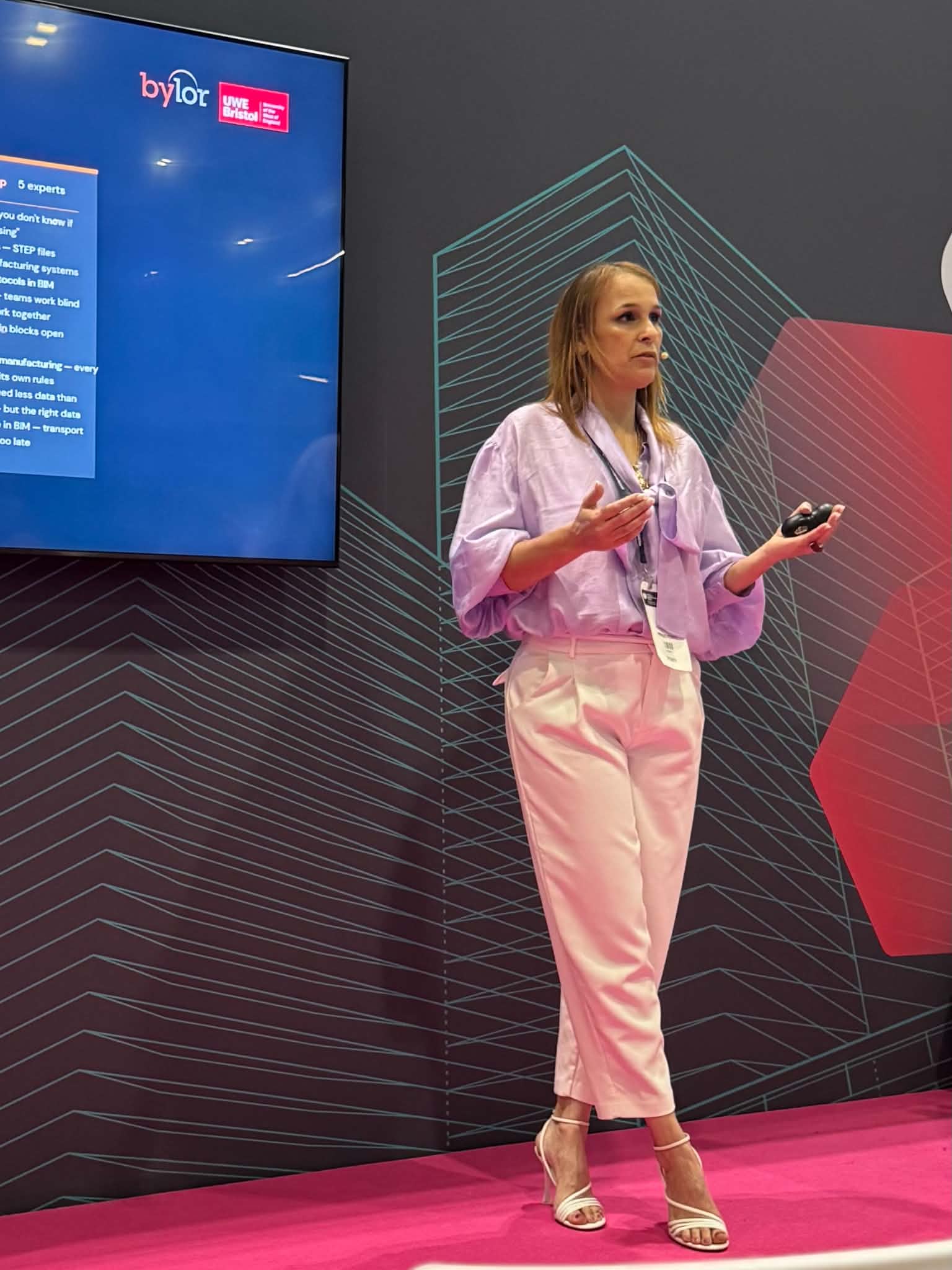
A researcher. A lead digital engineer. A mother.
My path into construction didn't start in construction at all.
My first job was as an interior designer in Portugal. I noticed something most people walked past. Many homes weren't designed with enough care for how people actually live in their space.
I started pioneering 3D design early, around 2003. I used 3D Studio Max and AutoCAD to walk clients through photorealistic renders before a single wall was built. I was always trying to optimise space. But I never lost sight of what the client actually needed.
When I moved to the UK, that career didn't transfer. My background was in fashion design, not architecture. The interior design door closed.
I kept working with design in other ways. I worked with an architect on building regulations and planning permission, measuring buildings and designing interiors. I later ran my own design business, working on a house extension, a site development model, and a wet room for Swansea University Trinity Saint David. I also produced visualisations and walkthroughs for an architecture firm.
I went back to university. I studied Building Studies first. Then Project and Construction Management. The subject came easily. A new path opened up.
I joined ISG as a BIM Coordinator in my final year of a Masters in BIM in Design, Construction and Operations at UWE Bristol. I worked on structural and architectural modelling for major projects including Amazon Avonmouth, Darlington, and a Nationwide building. I also learned laser scanning there. A field I loved and never got to fully return to.
It was during this time, around 2016, that I told my colleagues something they didn't take seriously yet. I said construction engineers wouldn't just use proprietary systems someone else built. The industry was dependent on what those systems allowed.
I finished my Masters and moved to Wernick Buildings as a BIM Manager. This is where I started building tools myself instead of just using them. I created the first coordination model that combined structural, architectural and fit out together. I introduced the first clash detection process and the first 4D animation used to train shop floor staff for assembly. In 2019 I built the company's first augmented reality application using Unity. I added 360 image walkthroughs and QR codes that linked tender documents straight to 3D visualisations.
My PhD began as one problem, supported by a director who believed in the work. When circumstances changed, I had to find new sponsorship and direction. By then I had moved to a major UK nuclear infrastructure programme, where I saw the same coordination problems I had encountered at Wernick, but at a much larger scale. The gap between BIM models and the manufacturing information fabricators actually need. A gap costing 16 to 24 hours per conversion. A gap that routinely caused file corruption and lost data. I redirected my research toward solving it.
Six years later, OffBIM is the result. Not a side project. The culmination of everything that came before it, from interior design to digital construction.
When I look back at my own CV, from my first role to where I am now, I see someone who adapted to every challenge in front of her and kept building the thing that was missing, long before I had a name for it.
The prediction I made to colleagues in 2016 took six years to become real. OffBIM closes a gap the construction industry has worked around for years, not through, costing time, money, and material on every project that depends on it. It gives fabricators the manufacturing information they should have had from the model all along. That is not a small thing. It is the difference between an industry that adapts to its tools and one that finally has tools built for how it actually works.
We are in an era where people with deep domain knowledge can build those tools themselves. I built mine. The industry doesn't have to wait for someone else to build the rest.